Can A Beginner Do Class 4 Rapids? A Grand Canyon Rafting View
A straight answer for first-time rafters weighing Class 4 whitewater against the beginner-friendly Grand Canyon trips you can actually book, with prices and safety facts.
Can A Beginner Do Class 4 Rapids?
A complete beginner can be a passenger on a Class 4 run when a professional guide powers the boat, which is exactly how the Grand Canyon's commercial whitewater works. Rowing or paddling Class 4 water yourself, unsupervised, is a different sport and not a beginner's first move. Around this park the realistic ladder is a smooth-water float first, then a guided whitewater day, then a multi-day trip once you know how your body reacts to cold, big water.
The question hides an important distinction. Rapids are rated on the international scale from Class 1, which is moving water you could swim in, up to Class 6, which is considered unrunnable except in rare conditions. Class 4 sits in the upper-middle of that scale: powerful water, unavoidable obstacles that require precise maneuvering, and a real chance that a swim ends in a long, uncomfortable rescue. That is why the honest answer starts with who is holding the oars.
On every commercial Grand Canyon river trip listed on this site, the answer is a trained guide. The National Park Service authorizes a fixed set of concessioners to run the Colorado River through the canyon, and their motorized rafts and oar boats are rowed by crew who have run the same stretch of river hundreds of times. A first-time passenger's job is to sit where they are told, brace when they are told, and hold on. That is a legitimate way for a beginner to experience hard whitewater, and thousands of people do it every season.
What a beginner should not do is treat that passenger seat as proof they can now handle Class 4 on their own. Private permits for the Grand Canyon are drawn by a weighted lottery the park runs each February, and the park itself says commercial trips are often reserved a year or two ahead. Nobody should be learning to read Class 4 water inside the Grand Canyon.
For readers who want the short version: the three trips above bracket the beginner range nicely. The West Rim whitewater day is the guided big-water option, the Horseshoe Bend float from Page is smooth water with zero rapids, and the three-hour motorized raft below Hoover Dam sits between them, moving water with no rapids to fight.
What Class 4 Water Asks Of Your Body
Class 4 rapids demand sustained physical effort, the ability to follow shouted instructions instantly, and enough swimming competence to stay calm in cold, aerated water if you go overboard. None of those are extreme athlete traits, but all of them fail in the same place: exhausted, cold passengers make late, wrong decisions. If you cannot swim confidently or you panic when water hits your face, start on a float, not in the big stuff.
The physical side surprises people. Even as a passenger, a whitewater day means bracing through wave trains, hauling yourself back into balance repeatedly, and often helping carry gear at stops. Trips run long: the West Rim whitewater day is a full 8 hours from the Hualapai Lodge departure at Peach Springs. Cold water is the other constant. The Colorado below Glen Canyon Dam runs far colder than a lake in summer, and cold water saps strength and coordination faster than most beginners expect.
The mental side matters just as much. Guides give commands like "left side, paddle" or "down and hold" in the second before a wave hits. A beginner who hesitates or freezes changes the boat's weight at the wrong moment. Guides plan for that, and their pre-trip safety talk covers the exact commands the trip will use, but the passengers who enjoy Class 4 water are the ones who treat instructions as immediate, not optional.
None of this means beginners are unwelcome. It means the Grand Canyon's commercial model exists precisely so that beginners can meet hard water with a professional between them and the consequences. Reading the safety picture in full is worth a dedicated pass, and the guide to Grand Canyon rafting safety walks through water temperature, life jackets, and what the operators themselves say.
Which Grand Canyon Trips Can A Beginner Actually Book?
Every trip on this site is bookable by a beginner, because every one runs with a professional guide or crew: seven Black Canyon floats from Las Vegas, two smooth-water floats from Page, one West Rim whitewater day, four helicopter-and-raft combinations, and two multi-day camping trips. The differences are intensity, duration, minimum age, and price, not a skill requirement. Only the multi-day trips ask for real prior consideration. If you're curious how safe these guided runs really are, our guide to whitewater rafting fatality rates explains why no reliable figure exists and what really drives risk.
| Trip (decision name) | Type | From price | Guest rating | Guided | Beginner fit |
|---|---|---|---|---|---|
| 1.5-Hour Float, No Transport | Short Black Canyon float | $69 per person | 4.9 from 254 reviews | Yes | Easiest entry |
| 3-Hour Motorized Raft, Lunch | Black Canyon float with meal | $140 per person | 4.8 from 413 reviews | Yes | Easy, most-reviewed |
| 5-Hour Float, Lunch Excluded | Page smooth-water float | $149.51 per person | 4.9 from 194 reviews | Yes | Easy, ages 4 and up |
| Whitewater, Helicopter, Skywalk | West Rim whitewater day | $688.85 per person | 5 from 4 reviews | Yes | Guided big water, age 8 minimum |
| 3-Day Camping Trip, All Meals | Multi-day Colorado River | $1855 per person | New listing, no reviews yet | Yes | Fit beginners ready to camp |
Read that table as a ladder rather than a menu of equals. The bottom rung asks nothing but a seat on the boat. The top rung asks for three days of camping and river rhythm. The middle is where most first-timers land, and the sections below take each rung in turn.
One caution on ratings: small review pools say little. The West Rim whitewater day shows 5 from 4 reviews, which is a perfect score from four guests, not a verdict. The 3-Hour Motorized Raft, Lunch, at 4.8 from 413 reviews, is the pool you can actually lean on.
Smooth Water First: The Floats That Teach You The River
A smooth-water float is the correct first trip for a nervous beginner, and around the Grand Canyon there are two honest versions: the Black Canyon below Hoover Dam and the Lees Ferry to Horseshoe Bend stretch from Page. Neither has rapids. Both put you on the Colorado River inside canyon walls, with a guide narrating, at a fraction of the effort whitewater demands. If you're curious how these calm stretches compare with the canyon's famous whitewater, a plain breakdown of the Grand Canyon's rapid classes shows which trips hit big water and which stay smooth.
The Page float deserves its popularity. It runs about 5 hours, covers roughly 10 river miles of smooth water, includes the bus from Page to Lees Ferry, and carries a minimum age of 4, which makes it the family answer to this whole question. One guest review on the listing puts it plainly: "The float was easy, informative, fun, and safe for all ages. Every part of it was a positive experience." A second calls the guides super knowledgeable and the experience relaxing. That is the tone of a trip a beginner cannot get wrong.
The Black Canyon floats are even lower commitment. The water there sits in the low 50s Fahrenheit year round, the park reports paddling conditions year round, and the canyon below Hoover Dam is a designated National Water Trail, about 30 miles of it, ending at Willow Beach. The Hoover Dam 1.5-Hour Raft Tour in Black Canyon is the shortest guided option on this site, from $69 per person, rated 4.9 from 254 reviews, with no transport to arrange beyond getting to the launch.
Guests on that short float report exactly what a beginner hopes for. One review reads, "This tour is a great opportunity to see Hoover Dam from an angle that others will never see. Great guide and very safe." Another mentions kids playing in the water, a hot spring stop in a cave, and calls it a must do for anyone visiting Hoover Dam. The full picture of that corridor is in the Hoover Dam rafting guide, including which trips bundle Las Vegas transport.
A float will not tell you whether you can handle Class 4 water. What it does is cheaper and more useful: it tells you how you feel on cold river water, in a life jacket, inside a canyon, for hours. People who hate that feeling on a float would be miserable in a rapid.
The West Rim Whitewater Day: The Guided Answer For Beginners
The one-day whitewater trip through Grand Canyon West is the closest thing to a beginner-safe Class 4 experience you can book from Las Vegas, because guides run the motorized raft, the minimum age is just 8, and the day ends with a helicopter lift from the river to the rim. The listing on this site, Grand Canyon West: Whitewater Rafting, Helicopter, & Skywalk, runs from $688.85 per person with ground transport from Hualapai Lodge, lunch, and the Skywalk included. If you'd rather make the journey on your own schedule, our guide to driving yourself from Las Vegas to the Grand Canyon compares the real costs and effort against tours like this one that bundle transport in.
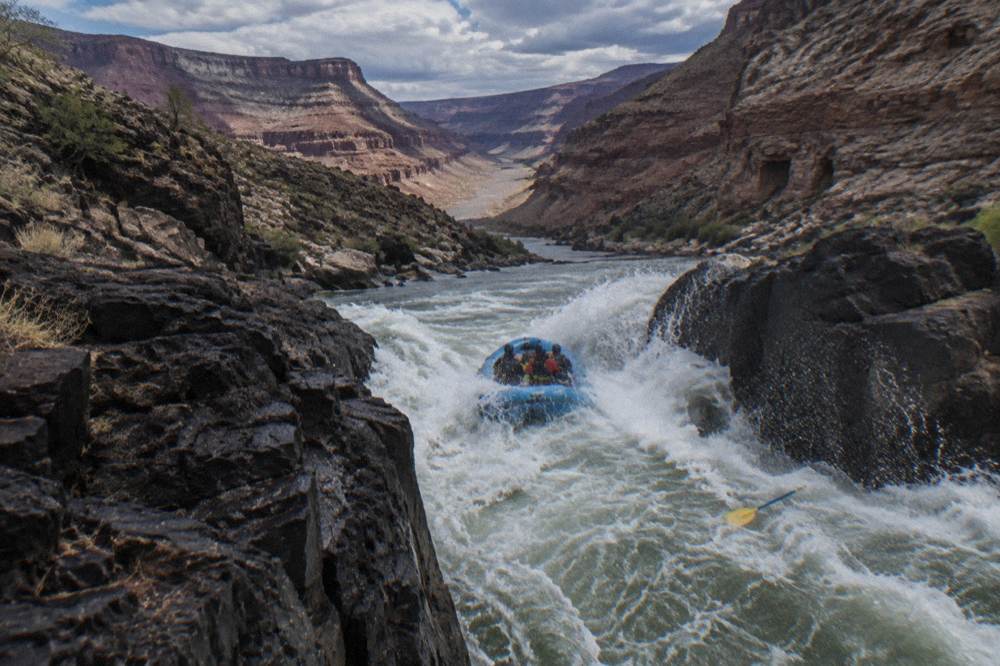
The operator is Grand Canyon Resort Corporation, the Hualapai Nation's enterprise, and the trip launches at Diamond Creek near Peach Springs rather than at Grand Canyon West itself. The official river runners page describes the day as a motorized raft through rapids and calm stretches, an optional guided hike to Travertine Cavern Falls, lunch on a sandy beach, and cultural interpretation from Hualapai guides, with the season running April to October. Every one of those ingredients is beginner-compatible: the crew handles the water, the passengers absorb the canyon.
For a first-timer weighing Class 4, the structure of this day matters more than its rating. You get hard water in doses, with calm stretches between, a guide who reads the river for a living, and a fixed endpoint. It is the format the commercial Grand Canyon has used for decades, shrunk to a single day. Beginners who want to compare it against the float options can start from the Las Vegas whitewater guide, which lays out the Las Vegas departure logistics.
Book it with the right expectations. The listing shows 5 from 4 reviews, a small pool, so let the itinerary sell you rather than the stars. Cancellation on this specific listing is free up to 24 hours in advance. And treat the 8-year minimum as the floor it is: the park and operator set age limits for physical reasons, and an adult beginner should respect the same logic in reverse, knowing your own limits is part of the deal. More of these guides are collected on Grand Canyon Rafting Tours.
How Hard Is The Grand Canyon's Whitewater, Really?
The Grand Canyon's rapids are widely considered among the most celebrated whitewater in North America, but this site does not print rapid-by-rapid class ratings, and neither should a beginner's planning rely on them. Ratings shift with water level, and the same rapid can be a different beast in April than in August. Read the operator's own rating language on the live listing, and trust the guide over any number on a chart.
This is the point where honesty beats a tidy table. This site gives no class numbers for named Grand Canyon rapids, because a rapid's rating shifts with the water level.: a class rating is a snapshot of one rapid at one flow. The Colorado below Glen Canyon Dam is dam-controlled, and the Bureau of Reclamation's releases change month to month, which changes the water everyone rides. A beginner asking "is it Class 4?" is really asking "will it be too much for me?", and that question is better answered by format than by numbers.
By format, the ladder is clear. The park's own page on one-day river trips notes the only one-day options are the smooth-water Lees Ferry floats, which tells you the park considers full canyon whitewater a multi-day, fully guided affair. Everything harder than a float here comes with professional crew, minimum ages, and safety talks. If you want a deeper look at how rapids are graded and why ratings drift, the rapid classes explained post covers the scale itself.
The practical takeaway for a beginner: do not shop by class number, shop by structure. A guided motor raft through big water with a calm-stretch landing and a helicopter exit is a beginner product. A private, self-guided run at any class is not, and in the Grand Canyon it also requires winning a lottery most applicants lose.
Fitness, Age, And Who Should Wait
Honest gatekeeping: strong swimmers in reasonable health can book any guided trip here, non-swimmers and anyone with heart or mobility conditions should stay on the smooth-water floats, and children are limited by each trip's stated minimum age, from 4 on the Page float to 8 on the West Rim whitewater day. Physical preparation helps less than picking the right format in the first place.
Age floors are printed on listings, not guessed. The Page float lists a minimum age of 4. The West Rim whitewater day lists 8. Multi-day operators set their own, commonly in the 8 to 12 range depending on trip length and boat type, so the booking page is the authority. There is no single park-wide minimum for commercial passengers; each concessioner sets its rules within its permit.
Adults should apply the same test honestly. Ask three questions. Can you swim 50 yards in clothes without panicking? Can you hold a brace position while cold water hits you? Can you sit on a boat for hours, then sleep on a pad if you choose a multi-day trip? Two yeses out of three points to a float plus the West Rim day. One yes points to the floats alone, and that is a perfectly good Grand Canyon river trip.
Worth repeating from earlier: cold is the hidden variable. A review from the three-hour Black Canyon float advises, "Wear sunscreen even if it is cloudy and cool." That is float advice, in the easiest water on this site. Scale the mindset up for whitewater. Packing for it has its own page, and the what to wear rafting guide handles layers, footwear, and sun protection in detail.
Multi-Day Trips: When A Beginner Levels Up
A multi-day Grand Canyon river trip is a legitimate beginner trip in the sense that no prior rafting skill is required, guests ride with professional crew, and meals are provided. It is not a beginner trip in stamina terms: three to eighteen days of camping, cold water, and daily whitewater. This site lists two such trips, both new listings with no reviews yet, from $1855 and $3420 per person.
The National Park Service authorizes 16 commercial companies for these trips, running 3 to 18 days from Lees Ferry downriver, with contracts running through 2033, and the park warns that seats are often reserved a year or two ahead. The Las Vegas: 3-Day Grand Canyon Rafting & Helicopter Tour bundles transport from and to Las Vegas, all meals, camping, and a helicopter component, from $1855 per person. The Grand Canyon: 6 Day Motorized Raft Trip with Meals & Flight goes deeper, from $3420 per person. Both are new listings, no reviews yet, which is a reason to read the operator's itinerary closely, not a reason to avoid them.
A first-timer choosing between the West Rim day and a multi-day trip is choosing between a taste and a lifestyle. The day trip sends you home to a hotel bed. The multi-day trip makes the river your home, with everything that implies: no showers, weather exposure, and rapids as a daily feature rather than a single event. Beginners who thrive there are the ones who already know they love being outside for days, which is why the multi-day trips guide deserves a slow read before any deposit.
The pricing logic is worth a glance too. Multi-day river trips look expensive until you divide by the day: three days of guided whitewater, food, and helicopter transport at $1855 works out cheaper per day than many single-experience tours, and the cost comparison guide breaks the whole budget down.
How To Choose: A Decision Table For First-Timers
Choose by your weakest link, not your ambitions: if swimming or cold is the worry, book a float; if time is the constraint, book the West Rim whitewater day; if you want the full canyon and can camp, book the 3-day trip. The table below matches the most common beginner situations to the trips that fit them.
| If this is you | Best first trip | Why | From price |
|---|---|---|---|
| Never been on a river, short on time | 1.5-Hour Float, No Transport | 90 minutes, guide-driven, easiest exit if you hate it | $69 per person |
| Want the full easy day with lunch | 3-Hour Motorized Raft, Lunch | 6 hours door to door with transport, 4.8 from 413 reviews | $140 per person |
| Traveling with young kids | 5-Hour Float, Lunch Excluded | Minimum age 4, smooth water, Horseshoe Bend scenery | $149.51 per person |
| Want to say you did real whitewater | Whitewater, Helicopter, Skywalk | Guided rapids, age 8 minimum, helicopter exit | $688.85 per person |
| Want the canyon overnight | 3-Day Camping Trip, All Meals | No skill needed, but real stamina and camping | $1855 per person |
Notice what is missing from the table: any requirement that you train first. Operators do not screen for paddling ability on guided motor rafts because passengers are not driving. The screening that matters is the self-assessment in the fitness section above.
One structural note for readers building a whole trip: cancellation terms differ listing by listing, so read each booking page. The three-hour Black Canyon motorized float allows free cancellation up to 24 hours before the start time; the Papillon helicopter-and-raft combos run to 3 full days on one listing and 24 hours on another; the Page float from Aramark's page cancels up to 2 days in advance with a fee. There is no single rule, and the cheapest mistake on any booking is not checking this line first.
Common Questions About Beginners And Class 4 Rapids
Can a beginner do class 4 rapids?
Yes, as a guided passenger on a commercial trip, which is how every whitewater option on this site runs. Professional guides row or motor the boat, give you a safety talk, and call every command. Handling Class 4 water yourself, without crew, is not a beginner activity anywhere, least of all in the Grand Canyon.
Do you need to know how to swim to go whitewater rafting?
For guided trips, operators require you to wear a life jacket rather than pass a swim test, but honest trip planning says non-swimmers belong on the smooth-water floats, not in rapids. If you panic in deep water, a float below Hoover Dam or the Page trip to Horseshoe Bend will give you the river without the risk.
What is the easiest Grand Canyon rafting trip for a beginner?
The Hoover Dam 1.5-Hour Raft Tour in Black Canyon, from $69 per person, rated 4.9 from 254 reviews. It is 90 minutes, guide-driven, and on flat water. The next step up is the three-hour motorized float with lunch, at 4.8 from 413 reviews, the most-reviewed trip on this site.
Is the Grand Canyon whitewater too hard for beginners?
The Grand Canyon's whitewater is serious, but its commercial trips are built around professional crew, which is why first-timers run it every season. The one-day guided format through Grand Canyon West, with a minimum age of 8 and a helicopter exit, is the beginner-facing version of that experience.
Should a beginner do a float or a whitewater trip first?
If you are unsure how you handle cold water, canyon hours, and a life jacket, do a float first: it costs between $69 and $149.51 per person versus $688.85 for the whitewater day, and it answers the comfort question cheaply. If you already know you want rapids, the guided West Rim day is a legitimate first trip.